


Editor’s Note: ***SIGH*** Another repost. At least, for the five people who may have read this when I originally posted it several years ago. I don’t think many saw it and it remains one of my favorites. I’m trying to get all of my content in the same place so you might see some dated stuff in this space over the next few weeks. However, this is not one of them.
Because bunkum is evergreen, baby.
********
I don’t know if this “Unnecessary Book Review” will turn into a series of articles - I don’t know if I’ll ever find a book like this one again - but I want to explain why I’ve called it “unnecessary.”
1. This book is out of print. There are a handful of used copies available online, but there’s certainly no market for it. No one is looking for advice on whether or not to buy it.
2. This book has no narrative. It’s a collection of scientific papers written by a few dozen authors with no connective tissue between them. Reviewing it as a single work misses the point entirely.
3. This book is about nonsense. That is, it’s a non-fiction book about fictional concepts. I don’t believe in psychokinesis, clairvoyance, telepathy, precognition, or any of the other mysterious forces the book’s authors attempted to prove. I don’t believe in them for what I feel are obvious reasons. If you disagree, you might not like this book review very much.
All of that said, the book begins:
“In the summer of 1974, J.B. Rhine disclosed to the scientific community that Walter J. Levy, then Director of the Institute for Parapsychology, had been discovered deliberately falsifying the experimental results of his PK research on rats with implanted brain electrodes.”
The first chapter, a research brief entitled “Continuation of the Rodent Precognition Experiments,” details how scientists replicated tests performed using a specially made cage. Researchers split the floor of the cage in half, and, at various intervals, electrified a randomly chosen side. If the test subject was on the half of the box that was not electrified, they marked the trial a “hit” - evidence that the rodent might be able to predict the future.
The paper details the methodology exactly. They tested 38 gerbils with an average of 98 trials per animal. Data was collected to track when the gerbils switched sides of the cage, how often they switched, and whether the switch occurred immediately after being electrocuted. Variables like the light/dark cycle they were kept under, the arrangement of their pens, and the intervals between electrocutions were all carefully controlled.
Researchers conducted four series of tests. Of them, only one obtained “marginally significant” data. The rest seemed to suggest that the gerbils were not psychic. “So far, these results seem to demonstrate a weak and unreliable effect at best. It will be a matter for individual researchers to decide whether the work warrants further time, energy, and expense.”
********
On a recent trip to Detroit, my wife and I visited John K. King Used & Rare Books - a four-story warehouse filled with obscure and out of print gems. In this monument to forgotten literature, one title seemed to call to us from the stacks: “Research in Parapsychology 1975: Abstracts and Papers from the Eighteenth Annual Convention of the Parapsychological Association.”
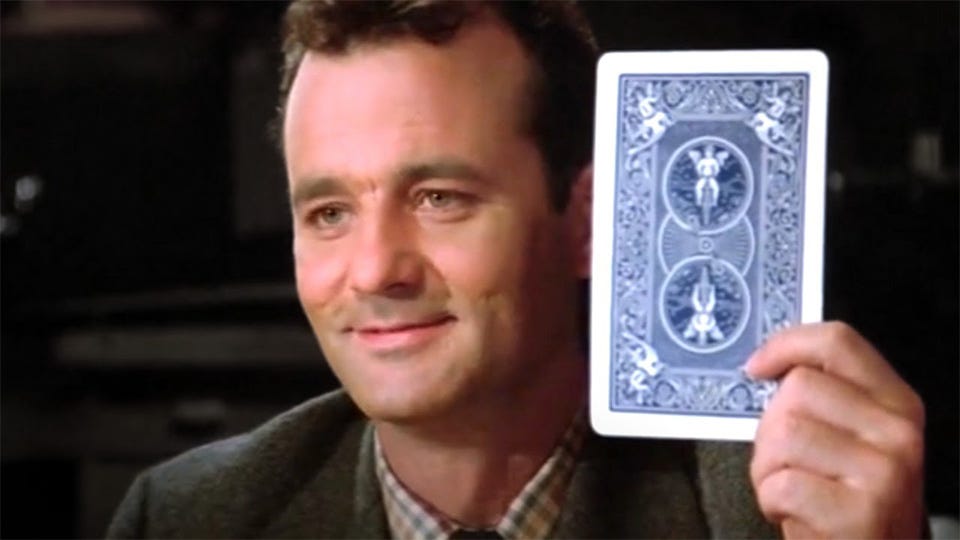
Leafing through it, I kept thinking of that scene in Ghostbusters where Bill Murray tests two college students with ESP cards and an electric shock machine. I bought it strictly based on that, but after further reading, I can confirm that there are more similarities than differences.
In the 1970s, the paranormal enjoyed a brief period of credibility. Uri Gellar and other charlatans made fortunes by reframing magic tricks as legitimate phenomena on talk shows. It wasn’t new when they did it, and I’m sure it’s still going on today in some form or another. But back then, with a significant fraction of society fooled, scientists around the world found themselves debating fairytales.
Moreover, the bar for significance was shockingly low. Any test result that involved psychic prediction - cards, numbers, sides of an electrified cage - was significant as long as it occurred “above chance level.” Forget about the sort of fortune-telling you might get from a strip mall psychic, if you guessed a coin flip 100 times and got it right more than 50 — even if by only one — then you might have the shine.
The researchers seriously accepted even the faintest evidence with an implicit bias toward the supernatural that permeated everything they did.
And that’s what makes everything they did so damn funny.
*******
In one experiment, test subjects were instructed to meditate with halved ping-pong balls covering their eyes as two 150-watt lights illuminated the room and river sounds echoed over loudspeakers. The subjects were guided by a researcher to visualize themselves walking along a stream, preparing their minds to telepathically receive an image from another researcher concentrating in a nearby room. After the meditation was over, the subjects were asked to pick the correct image from four potential choices- to test their clairvoyant abilities.
Had this experiment been successful, you probably would have heard about it by now. Although some subjects were labeled “hitters” for guessing with 39% accuracy, in the end, “the results showed no predictive power for clairvoyant or multisensory GESP targets.”
But the real story of this experiment can be found in a brief admission wedged amongst all of the other scientific-sounding facts and figures. “The attendance varied from 25 at the first session to five at the last session,” suggesting that four-fifths of their test subjects hypothesized that this was a giant waste of time.
Another experiment attempted to recreate previously successful results by having subjects alter the temperature inside a thermos. Subjects were instructed to make the contents hotter or colder using only the power of their mind. One after another, volunteers entered a room, stared intently at a thermos for several minutes, and then left.
The results were predictable.
Throughout the book, the scientists are careful not to rule out anything. Instead of concluding that it’s simply not possible to change the temperature with your brain, researchers suggested several alternative explanations for the poor results. “The subjects’ preparation for the PK task was inadequate, the experimental atmosphere was too sedate and orderly, and the selection of subjects was less favorable than before.” If not for these issues, we’d all be reheating coffee with our minds.
Some of the experiments are thoroughly steeped in the period, which adds an extra layer of fun. It encourages you to picture mad scientists with afros, peasant blouses, and the lapels of their dress shirts tickling their armpits.
One such experiment tested need-based psychic ability by exposing subjects to a song by Serge Gainsbourg, “which we believed should cause arousal of sexual needs.” As evidence of the music’s erotic bona fides, the researchers noted: “The record... was one side of a 45-rpm disc entitled ‘Je t’aime ... moi non plus,’ sung by Jane Birkin and Serge Gainsbourg, which, using a context of music and occasional song, was obviously intended to portray human sexual intercourse.”
The subjects listened to the record and took part in a “Psi-Mediated Instrumental Response” test, where they were asked to pick the correct image from four potential choices. Unfortunately, “the playing of the erotically-toned record did not appear... to produce anything like the level of arousal we had hoped it might.”
Amidst all of this psychosexual chaos, there’s a very brief mention of a rigorous demonstration-of-ability test for Uri Gellar. This test also failed, but not due to a lack of psychic ability. “Unfortunately, Gellar did not show up for the scheduled appointment.”
*******
The book’s dry language begs you to fill in the gaps with your own details. For instance, there’s a fantastic experiment involving elevators. The paper is short, about three pages, and the test itself is one of the simplest. A researcher asked his subject almost a thousand times over the course of three years to predict which elevator in their building would arrive first after they pressed the call button.
Over a period of 42 months, a number of variations were tested, mostly adjustments to the length of time between the prediction and the test. Long-term projections, up to as much as 16 hours in advance, were conducted via phone call. “The subject would call me before going to bed, generally around midnight, and guess which elevator would arrive first the following day.”
For me, this felt like a clear story of unrequited love between researcher and subject. This is where all the parapsychology narratives live — in the spaces between the data.
Once upon a time, two young associate professors, Kevin and Richard, were both chasing tenure at a California university and forced to share an office. And though they were from two different worlds, they quickly grew to enjoy one another’s company.
They were an odd couple - one a party animal, the other your quintessential science geek. Kevin was an English professor who wore his hair long and had thick, bushy sideburns. Richard, an earnest and fastidious parapsychologist, was quieter and more conservative. You’d never expect these two to hit it off immediately, but that’s precisely what happened.
Kevin was everything that Richard wished he could be. He was carefree and brash, sometimes shockingly casual. He delivered lectures from the top of his head, hung out at the same bars as his students, and there was even a rumor that he smoked dope.
Without completely understanding why, Richard started staying at the office later, chatting with his new officemate. Their wide-reaching conversations could sometimes go on for hours as they explored each other. In fact, Richard enjoyed his time with Kevin so much that it began to trouble him. Kevin was cool. Really cool. And it felt good to bask in his glow. In quiet moments alone, Richard could admit to himself that he craved to be with Kevin. Never before had anyone caused him to feel this way - man or woman.
One night at the office, Kevin wandered over to Richard’s desk, glancing at some of his papers. “You really think there are people out there who can see into the future?” he asked.
“I think there are many things that we may not understand,” Richard said meaningfully. “Poltergeists... Extraterrestrials...”
“Women,” Kevin interrupted with a smirk. The cad.
“Yes,” Richard nodded with a frown, thinking of his poor wife waiting at home for him. “Women.”
“Well, I think it’s great,” Kevin said, adjusting his corduroy sport coat with patched elbows. He slapped Richard on the back, jostling his horn rims. “I hope you find one.”
And that’s when Richard had an idea, a way to spend just a bit more time with his new... friend. “Have you ever been tested for clairvoyant ability?” he asked. Kevin shrugged and shook his head.
The men trudged down the hall to the elevators - two brushed steel doors with a call button between them. “Left or right?” Richard asked, his heart in his throat.
“Left. Definitely.” Kevin pressed the button and, as though it were pre-ordained, the elevator on the left opened for them. They stood before it, their jaws agape as though they’d just witnessed a miracle.
“No fucking way,” Kevin said with a laugh. “Maybe I’ve got the gift.” He turned and smiled, then got on the elevator and rode it away.
The memory of this moment would linger in Richard’s private thoughts for a lifetime.
As the months went on, the two charted Kevin’s progress. It was a game they played. “What kind of day do you think it is?” Richard would ask. “Oh, definitely a left sort of day. Yesterday was all about right, but today it’s a lefty for sure.” About half the time he got it correct and they’d celebrate with applause and high-fives before embarking and heading home.
About a year in, Richard adjusted the time-frame variable in a ploy to expand his relationship with Kevin. Every night, the phone rang, curling the edges of Richard’s lips as he answered, asking the same way every time, “How do you feel tonight?”
So life went on, contenting Richard’s fantasies with routine. The experiment gave him just a sliver of the sweaty, visceral love he really desired from Kevin, but it was the sliver he could live with.
One morning, Richard waited for Kevin by the elevators, the heady scent of toasted gerbil wafting through the air. But Kevin never showed. After taking the stairs to preserve the sanctity of the experiment, Richard walked into their office and was shocked to discover Kevin’s belongings had been removed overnight.
The student newspaper would break a story that day about an unnamed associate professor who had fled the state after impregnating two coeds. You could do that back then, move cities and change your name, starting over like you were in witness protection and nobody ever caught on. It was the Seventies.
That was the last Richard ever heard of Kevin, though a distinct feeling of betrayal would linger for years. He published their research as a terse, three-page paper hidden in a long-lost book of dubious scientific value. And with that, Richard considered Kevin officially erased from his mind. But for the rest of his life, every time he pressed an elevator call button, it was with a pang of regret.
It’s pretty unlikely this is how it actually happened, this is just what I saw between the lines. However, in the spirit of parapsychological research, I should also note that nothing says it didn’t happen.
*******
So, what’s going on with all of this nonsense today?
Professor Chris French, the former editor of Skeptic Magazine and current head of the Anomalistic Psychology Research Unit at Goldsmiths, University of London, gave a speech at The Royal Institution in 2016 about the present state of the art. Naturally, a great deal has changed.
For one thing, the term “Paranormal Psychology” has been eliminated in favor of the unbiased “Anomalistic Psychology.” Professor French defines the term as “the study of extraordinary phenomena of behavior and experience, including (but not restricted to) those which are often labeled ‘paranormal.’ It is directed towards understanding bizarre experiences that many people have without assuming a priori that there is anything paranormal involved. It entails attempting to explain paranormal and related beliefs and ostensibly paranormal experiences in terms of known (or knowable) psychological and physical factors.”
In other words, the days of searching for proof are over. Although, Professor French is quick to add, “We’re not so dogmatic that we say, ‘We know paranormal forces don’t exist.’ An important part of skepticism is to always be open to the possibility that you might be wrong.” To that end, the experiments continue, albeit with a change of focus.
In “The Enemies of Reason,” a television documentary by Richard Dawkins, Professor French and his team evaluated self-professed “dowsers” - people who believe they can find underground water with a forked stick using paranormal senses. In a double-blind study, the dowsers tested a series of overturned buckets - some covering bottles of water, some bottles of sand. As you’ve probably already guessed, none of the subjects guessed significantly above chance level.
Instead of fixating on that result, however, the research is now focused on the psychology of the belief itself. Once confronted with the results of the study, the dowsers exhibited surprise. Some defended their abilities by telling anecdotes of when their powers supposedly worked. Some criticized the test itself. Today’s Anomalistic Psychologists are just as interested in these reactions as they are the test results.
*******
Having made my own biases crystal clear, it might surprise you to know that I love this book. It’s far and away one of the best impulse purchases of my life. It’s a quick read, with short, amusing chapters. It’s funny, it’s weird, and it’s about a colorful time in history. I felt like I learned a lot, even though I didn’t.
Throughout, I was struck by the sensation that I was reading one of those dated articles about “The World of Tomorrow,” and how bright and wonderful the future might look. But instead of flying cars, the authors fervently believed that they were on the cusp of a discovery that would fundamentally challenge the nature of the world. And I have to admit, I was a little sad when I got to the end without them finding it. Spoiler alert, I guess.
The irony is that the book does its best to convince you there are strange and wonderful powers in the world using the most scientific techniques available. But after reading, I’m now more convinced than ever that there is no such thing as the paranormal.